
I have a memory from childhood of watching an award ceremony for a girl who invented something incredible.
She created a wallet for the blind. You put the money into it, and it announced the value out loud. Keep in mind, this was in the 90’s. It was impressive. I was in awe. Not just of the invention, but of the recognition.
I thought to myself, “That’s it. That’s what I want to do. I want to invent something that will be so important that I’ll be remembered for a long time.”
It was the start of a long road of working my ass off to do something meaningful with my life. Something that could become my legacy.
Every time I’d learn about a respected historical figure, elite athlete, or titan of industry, I’d think, “I want that. I can do that.”
Because what better measure of a life well lived than one’s reputation? Who wouldn’t want a reputation so powerful that it ripples through culture long after one dies? If I’m not worth remembering, then what is my worth?
I appreciate the parts of me that have held these concerns since I was a wee lad. They want my life to have meaning.
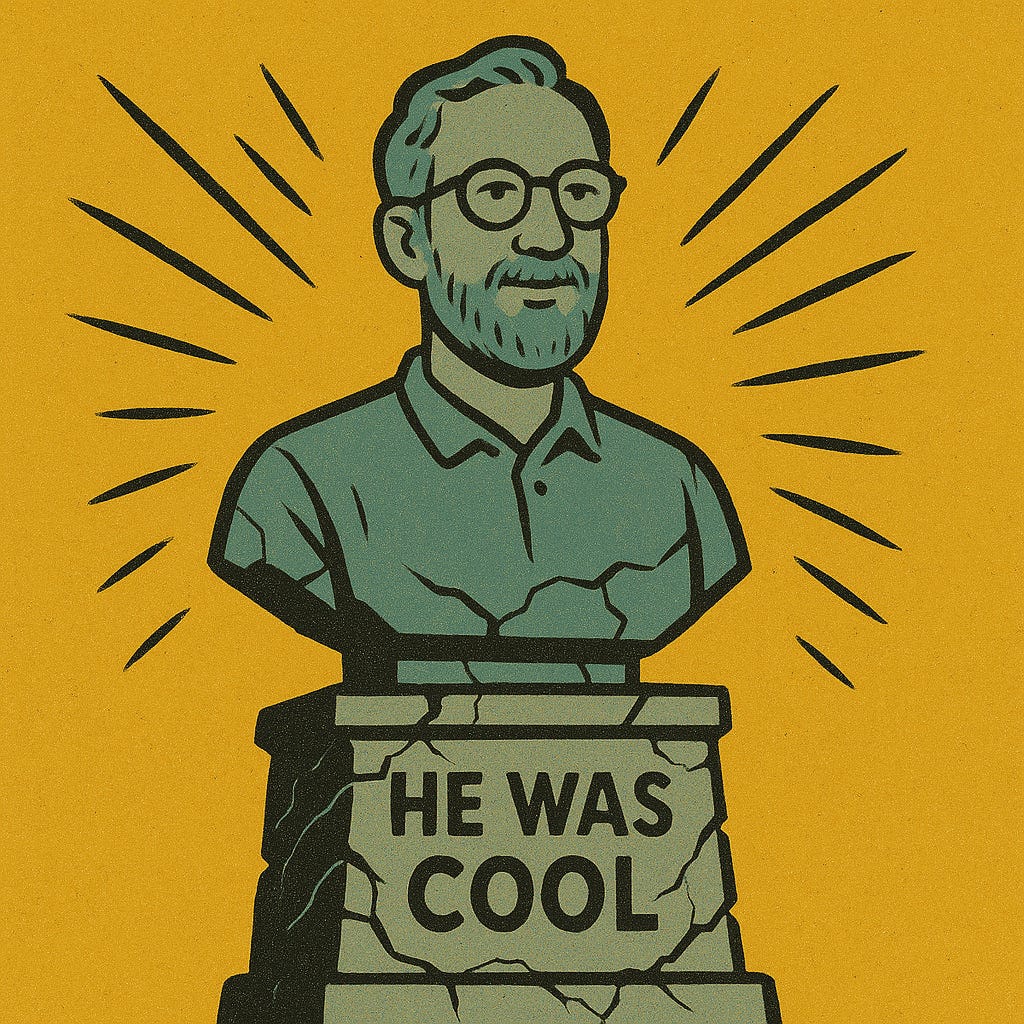
But if meaning is the goal, I’m starting to suspect that optimizing for legacy is a poor strategy.

First, my legacy is entirely outside my control. I can’t even control what people think of me while I’m alive! What makes me think I can control the story that’s told about me after I’m dead?
Legacies are never accurate representations of the people being remembered. Not even close. They’re summaries of an infinitely complex human, translated through the world views of the biased people who tell their stories.
Like, Jesus is 99.999999999% metaphor at this point. I’m sure if he does get resurrected, he’d be like, “You think I did WHAT?!”
I can’t control who tells my story, and I can’t control the story they tell.

Second, I have no idea what I would have to do in this lifetime to be remembered.
Looking at many of the people that we study in history classes, they weren’t trying to leave a legacy…
Socrates never wrote about his philosophy. He didn’t try to start a movement. He just asked lots of questions. At least we think that’s what he did. We only know about him through his students’ writing.
Rosa Parks wasn’t trying to start a movement. She made one courageous choice in one moment, and it rippled through history.
Anne Sullivan was simply focused on one student, Helen Keller, and as a result of her work, we never saw disabilities the same way again.
Meanwhile, there have probably been millions of people who were big deals during their lifetime, and forgotten about almost immediately after they died.
The actions and reputation we have while we live are not predictive of how we’re remembered. Sometimes small things become big. Sometimes big things are forgotten overnight.

Third, focusing on legacy prioritizes that which can be retold and remembered. So instead of doing a good thing, I become motivated to do the thing that will be remembered as being good. A subtle difference that’s worlds apart.
Say, for example, I see a homeless person on the street. The good thing might be to offer them some food. But if I’m optimizing for legacy, that’s not enough. I need others to know that I offered them some food. So maybe I don’t offer it at all if there are no witnesses. Or perhaps I offer them food, and then tell my wife about it, ensuring that my act is remembered.
The entire intention of the action is undermined. A good act becomes a manipulation of ego. It becomes about me rather than the person I’m supposedly serving.

Lastly, I notice that when I focus on legacy, I’m projecting meaning out into some future date.
Instead of finding meaning here in this moment, I’m optimizing for this moment to matter later, long after I die, when I can’t even experience it!
Now is the only moment that exists. Everything else is a projection. An extraction. A distorted reflection. So meaning can only exist now.
And every moment is bursting at the seams with meaning if I can just be with it fully. It doesn’t matter what I’m doing. Meaning is always waiting there when I drop into presence.
Here’s where I land on legacy today…
Our true legacy isn’t what’s said about us. It’s not how we’re remembered. It’s not our accomplishments.
Our true legacy flows out of every micro action we take in our lives.
Loving actions like giving food to that person in need, or the warm glance I exchange with my wife at the end of a long day of parenting, or holding the door with a smile for a stranger who was having a rough day.
And actions that aren’t so loving, like when I act out of spite, or fear, or jealousy.
Even actions that seem tiny and insignificant, like taking a deep breath, or pausing to appreciate the way the light is hitting the leaves of a tree.
Every small action sends out vibrations that ripple out into the universe, weaving, and compounding, and dancing together for all of eternity.
That is my legacy.
That is all of our legacies.
To paraphrase John Lennon (I wonder what his legacy is), legacy is what happens when we're focusing on other things.
And to paraphrase "Mean Girls" (now that's legacy), stop trying to make legacy happen.
Legacy is a kind of illusion, as are any of the ways we project ourselves into the past or future. We make our marks in small ways, in the present, in the way we move in the world and connect with others. (Of course this aligns with what you're saying, and what Buddhism as well as other Eastern religions and New Age theorists have said. There's nothing truly new under the sun, eh?)
Holding the door for a parent with a stroller. Smiling at your barista. Taking a moment to comment on each other's Substack posts. Or, as you suggest, simply breathing a peaceful breath in a chaotic world. These are our legacies, larger than we imagine.